Holocaust
Impure BloodThe Holocaust is the novel’s defining historical rupture: it destroys families, leaves identities concealed across generations, and becomes the contested ground on which the living debate guilt, truth, and revenge. Through the fate of the Djourescu family and the belated revelation of Jean Florian’s birth, the novel connects the persecution of Jews under Nazi occupation to a later family crisis without treating inherited trauma as a simple substitute for individual responsibility.
Historical Persecution and Family Separation
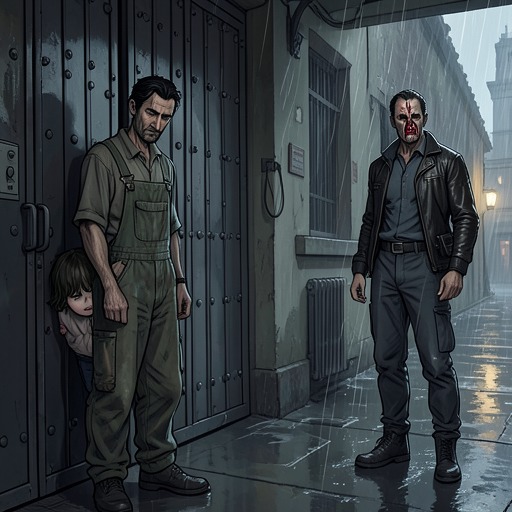
Madame Laseige’s memory begins with two neighboring households on the top floor of an apartment building. As a young mother, she helped Louise Florian when Louise gave birth; the pregnancy had not been difficult, but something went wrong near its end, and the baby was stillborn. Elena Djourescu gave birth to a healthy boy only hours later. This sequence matters because it contradicts the account that Frankie had read in a report, which had attributed the premature birth and death to Elena. The correction establishes that the story’s family histories have been distorted, and that recovering them depends on witnesses whose memories preserve details official accounts have misplaced.
The remembered raid makes the consequences of persecution personal and immediate. Adam Djourescu ran between the apartments carrying first his newborn son, then a bundle that was no longer alive. Soldiers entered the building and went directly to the stairs, as if they already knew where to find their victims. They took the Djourescus away to the trains; Madame Laseige never saw them again. The scene links the private losses of birth and family separation to the machinery of deportation, while the changed bundle gives the family’s fate a stark, intimate measure.
Deportation and the Murder of the Djourescus
Emil Florian’s letter to Jean supplies the next generation with a history Jean had not known. After their father’s death, Emil informed Jean that he should expect no inheritance because, Emil claimed, Jean was not a true Florian. He disclosed that Jean had been a Jewish baby given away at birth and identified Adam and Elena Djourescu as Jean’s biological grandparents. Their betrayal by a fellow officer, the letter said, had led to their deportation and death at Auschwitz. Emil’s mother had apparently known the story but not the informant’s full identity; Jean had only a first name, Vincent.
The revelation makes Jean’s origins inseparable from a history of persecution and concealment. He passed what he had learned to his son David because David needed to know what had happened to his true grandparents. It also helped Jean understand the Florians’ changed treatment of him after Emil entered the family: once Jean was no longer the favored son, he was treated with contempt. The account does not turn that explanation into an excuse. Jean recognizes that he later treated his own wife and son badly, repeating in his own household a pattern of emotional neglect.
Historical Guilt and Competing Accusations
David Jarret turns the family history into an accusation against Vincent Dantier. During the confrontation with Agnès Dantier and Vincent, David invokes October 1943 and says Vincent sent his grandparents and aunt to Auschwitz. He describes the camp as a place of forced labor and mass murder, and insists that his relatives were not merely lost in an old story: they were people killed in a system whose violence David lays directly at Vincent’s door.
Vincent answers by invoking obedience. He says he was following orders, as David’s grandfather had done earlier, and states that the grandfather had consigned Jews to their deaths in 1942. David rejects the comparison: in his account, Vincent acted on his own initiative and informed on the grandfather to remove a workplace rival and advance himself. He presents the denunciation as a betrayal motivated not by obedience but by ambition. The exchange stages a distinction between institutional complicity and personal initiative, while leaving the historical account filtered through characters with sharply opposed interests.
Agnès challenges David’s claim directly, telling him that it is not true. Her response matters because the past is not offered as settled evidence simply because it is invoked with moral force. David uses the Holocaust to define Vincent’s guilt and justify his own hostility; Agnès contests the accusation even while she is caught within David’s attempt to make her bear the weight of her father’s alleged crime.
Inherited Trauma and the Present
After the crisis, Agnès describes the deeper meaning of her father’s history to Paul Darac. She says her father had sought to have a woman pregnant with his child taken away and exterminated, believing the baby had been stillborn that same morning. The child survived; Agnès’s account connects this concealed family history to her half-brother Jean. What wounds her is not only the attempted destruction of mother and child but the thought that her father later felt loss at never knowing the son he had tried to have killed. She judges her father’s actions against the crimes of Nazi leaders and refuses to soften them because he was her father.
That judgment does not bring uncomplicated closure. Agnès bitterly imagines contacting Jean and holding a party with Corinne Delage if Corinne recovers, then breaks into tears. Darac responds by holding her shaven head against his chest. The moment brings the historical record back to the living body of family grief without equating their present pain with the victims’ murdered lives. The past has revealed a half-sibling and explained part of the family’s estrangement, but it has not restored what persecution and betrayal destroyed.
Narrative Significance
The Holocaust enters the novel through layered recollection rather than a single authoritative account: Madame Laseige recalls the raid, Jean remembers Emil’s letter, and David reuses the inherited story in a confrontation. Each telling changes what the past means in the present. A discrepancy about which mother gave birth to the stillborn child, an informant known only by his first name, and the conflicting claims about obedience and ambition all make historical knowledge dependent on testimony, correction, and judgment.
The novel also distinguishes remembrance from revenge. Jean passed on the fate of his grandparents because he believed David needed to know; he says he sought reconciliation with his neglected son, not vengeance for the original crime. David, by contrast, turns the same history into a weapon against Vincent and Agnès. The Holocaust thus remains both the irreparable historical catastrophe at the center of the family story and the ground on which later generations struggle over whether inherited knowledge will lead to truth, responsibility, or renewed harm.